There was a time when reading faster felt like the solution. If a report was fifty pages long, the problem was obvious: finding enough time to read it. If a research paper was difficult, you had to work through it carefully. If someone sent you three articles before a meeting, there was a good chance at least one of them would remain unopened. AI changed that remarkably quickly. Today, we can paste an article into a tool and get the key points in seconds. A long report can become a few paragraphs, a research paper can be reduced to its main findings, and a video, meeting transcript, or document can be turned into something short enough to understand before your next coffee gets cold.
That sounds like the information problem has been solved, but there is another problem hiding underneath it. We can summarize almost everything now. The question is whether we will remember any of it.
Summarization Solved a Real Problem
AI summarization became popular for a very good reason: there is simply too much information competing for our attention. Articles, reports, papers, newsletters, documentation, meeting notes, videos, and internal documents keep arriving faster than most people can realistically consume them. Traditional reading requires time, while summarization gives us a way to quickly identify the main ideas and decide what deserves deeper attention. That is especially useful when the goal is triage. A researcher can scan several papers before choosing which ones to read fully, a professional can understand the structure of a long report before a meeting, and a student can use a summary to identify concepts that need more attention instead of reading every source with the same level of intensity.
The source article that inspired this piece makes the same basic case: summarization tools help people reduce long texts into shorter forms, understand key ideas faster, and save time across research and reading workflows. It also points out that this can be particularly useful for students, researchers, professionals, and people dealing with large amounts of information. That part is hard to argue with. Summaries are useful, but useful is not the same as memorable.
The New Problem Starts After the Summary
Imagine you are researching a topic for work. You find a useful article and ask AI to summarize it. The summary is excellent, so you read it and move on. Then you summarize a report. After that, you ask for the key points from a research paper. By the end of the afternoon, you have processed more information than you would have been able to read manually in several hours, and you feel productive.
Now imagine that three weeks pass. You remember reading something important about the topic, but you cannot remember which article it came from. You vaguely remember the conclusion, but not the context. You might even remember that an AI summary contained exactly the point you need, yet you have no idea where that conversation is now. The information was successfully compressed, but it was not successfully retained. That distinction matters because summarization reduces information, but it does not automatically turn information into knowledge.
A Summary Can Become Just Another Thing You Forget
We often think of summaries as the final result. The document was long, now it is short, and the problem feels solved. But from a knowledge perspective, the summary may only be another intermediate object. It can disappear into a chat history, a notes app, a document, a browser tab, or a folder alongside hundreds of other things we once considered useful.
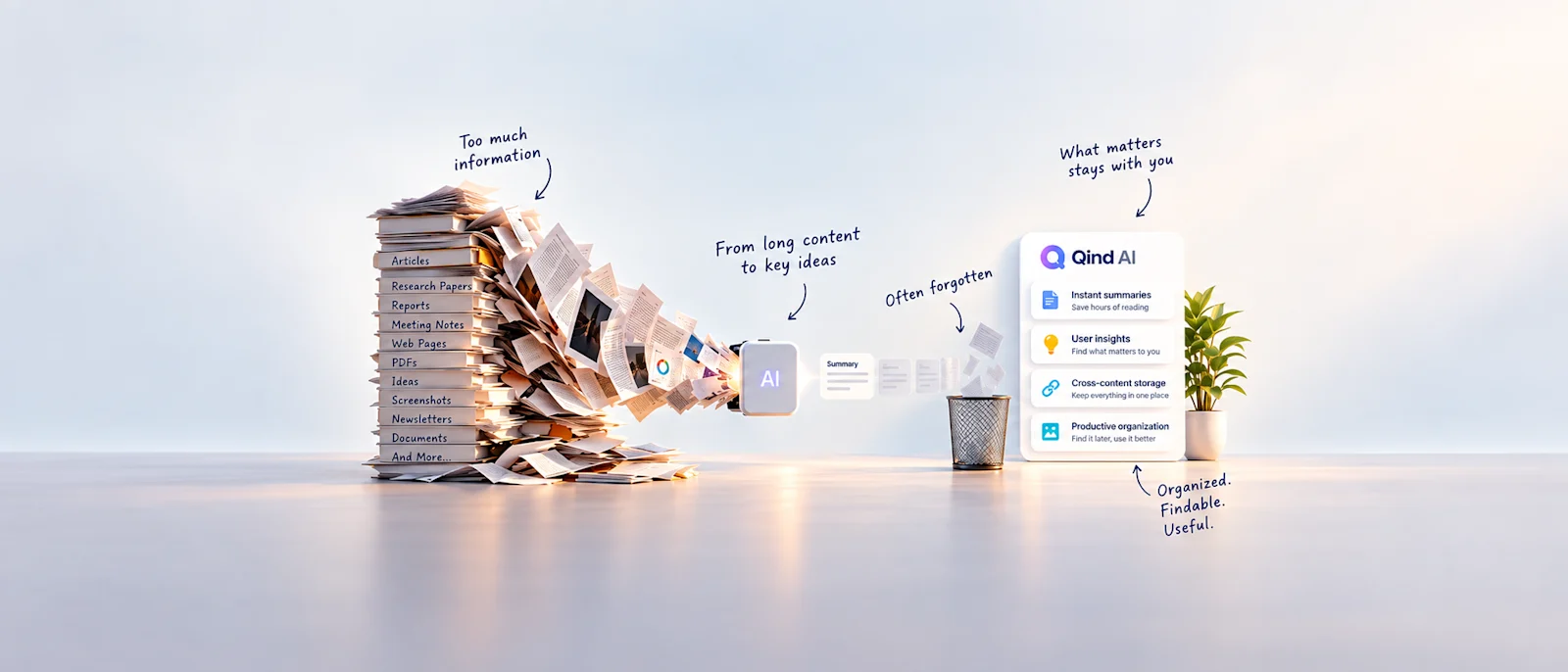
The irony is obvious. We started using summarization because there was too much information to manage, and then we began creating another layer of information that also needs to be managed. The original article, the summary, notes from the summary, a screenshot of an interesting sentence, a link saved for later, and a follow-up question asked in an AI chat can all end up living somewhere different. None of those things are necessarily bad. The problem appears when the context connecting them disappears. A shorter piece of information is easier to read, but it is not automatically easier to find again.
The Difference Between Compression and Understanding
Summarization is fundamentally a form of compression. A large amount of information becomes a smaller amount of information. Details are removed, repeated points disappear, and the main ideas become easier to see. That can make a complex document far more approachable. But understanding is something different. Understanding means knowing why the information matters, how it connects to what you already know, whether you trust it, what it changes, and when it might become useful again.
Two people can read exactly the same summary and take away completely different things. A product manager may notice a market implication, a researcher may focus on methodology, a developer may see a technical limitation, and a founder may see an opportunity. The summary is the same, but the meaning is personal. That is why reducing a document to five bullet points cannot, by itself, preserve everything that made the source useful to you.
Sometimes the Missing Detail Was the Important Part
There is another limitation worth remembering: every summary removes something. Usually that is exactly what we want. Nobody asks for a summary because they want every paragraph reproduced in a slightly shorter format. The value comes from deciding what is important and removing what appears less important. But importance is contextual.
A small methodological detail in a research paper might be irrelevant to one reader and critical to another. A sentence buried halfway through a market report might not belong in a general summary but could completely change a decision your team is making. The original source article also acknowledges this limitation. It notes that AI-generated summaries can lack some of the nuance and depth of the original material and may occasionally contain errors or inaccuracies. That does not make summarization unreliable or useless. It simply means we should treat a summary as a way into information, not always as a replacement for it.
We Are Consuming More Because We Can
AI has created an interesting productivity paradox. When reading was slow, there was a natural limit to how much information we could consume. We had to choose. If a report required an hour of attention, we thought carefully about whether it deserved that hour. Summarization dramatically lowers that cost. Now we can process ten sources instead of three, scan twenty articles instead of five, and ask for the key points from documents we might never have opened before.
That sounds purely positive, and in many ways it is. But when the cost of consuming information falls, the amount of information we consume tends to rise. The bottleneck moves. First the bottleneck was reading. Then AI made reading faster. Now the bottleneck is remembering what mattered.
Information Overload Does Not Disappear When Information Gets Shorter
Imagine receiving one hundred long documents. Obviously, that is overwhelming. Now imagine receiving one hundred summaries. Better? Absolutely. Simple? Not really. You still need to know which summaries matter, remember where an important idea came from, connect related information, and distinguish between something that was merely interesting and something that should influence a decision later.
Information overload is not only about word count. It is also about volume, fragmentation, context, and retrieval. A thousand perfectly written summaries can still become a thousand things you cannot find.
The Real Question Is What Happens After You Understand Something
This is where the conversation about AI summarization becomes more interesting. We spend a lot of time asking whether AI can summarize something accurately, how short the output should be, whether it can process a PDF, or whether one summarizer is better than another. Those are useful questions, and there are many tools designed specifically around making long content easier to consume. The source we reviewed, for example, discusses tools such as Scholarcy, Genei, SaveDay, QuillBot, and Summarizer as different approaches to reducing and processing long-form information.
But eventually another question becomes more important: what happens to the useful knowledge after you understand it? If the answer is “it stays somewhere in my AI chat history,” then the workflow is incomplete. If the answer is “I copied it into a random note,” the problem has only moved. If the answer is “I will remember it,” experience suggests we may be overestimating our future selves again.
A Good Summary Should Lead Somewhere
The most useful summary is not necessarily the shortest one. It is the one that helps you decide what happens next. Sometimes the correct next step is nothing. You read the summary, realize the source is not relevant, and move on. That is a successful outcome. Sometimes you need to read the original source. Sometimes you want to save an idea. Sometimes the information belongs to a project you are already working on. Sometimes it contradicts something you previously believed, and sometimes you know immediately that this will matter again three months from now.Those are fundamentally different outcomes, even if they begin with exactly the same action: asking AI for a summary. The real productivity gain happens when your system can distinguish between information you merely consumed and knowledge you decided was worth keeping.
This Is Where Qind Fits
Qind is not interesting here because the world needs another place to generate shorter text. The more important problem comes after summarization. When something in an article, PDF, note, image, document, or other source becomes useful, it should not have to disappear into another isolated information silo. The valuable part should be able to stay connected to the broader knowledge you are building.That means preserving more than the summary itself. It means keeping enough context that future you can understand why the information mattered. Instead of treating every research session, article, AI conversation, or document as a temporary interaction, useful information can become part of a knowledge space you can return to later. This matters because your future question probably will not be, “What was the exact filename of that report I read in September?” It will be closer to, “What was that idea I found about why users stop using a product after onboarding?” Humans remember concepts. Our storage systems often expect addresses.
AI Should Help Us Remember Better, Not Just Read Faster
The first generation of AI productivity tools has been very good at acceleration. Write faster, read faster, search faster, summarize faster. Those improvements are meaningful. Nobody wants to return to manually scanning every eighty-page report just to discover that only four pages were relevant.But speed is only one dimension of knowledge work. The next challenge is continuity. Can the idea you discovered today still help you six months from now? Can something learned during one project become useful in another? Can an important insight survive after the browser tabs close, the AI conversation disappears from your recent history, and you move on to the next urgent task? That is a very different definition of productivity. It is not about processing more information. It is about losing less of what was worth keeping.
Maybe We Do Not Need More Summaries
This does not mean we should stop summarizing things. Quite the opposite. Summarization is becoming one of the most useful interfaces between people and large amounts of information. Research, education, business, software, law, medicine, media, and countless other fields benefit when people can understand complex material faster.But perhaps the next improvement is not simply an even better summary. Maybe it is a better relationship between the summary and everything else we know. A useful idea should not become valuable for thirty seconds and then disappear. A summary should not be the end of the information journey. It should help us decide what deserves to continue.
The Goal Is Not to Remember Everything
Trying to remember everything would simply recreate the problem AI summarization was supposed to solve. Most information should probably be forgotten. Some articles are irrelevant, some reports contain nothing useful, some summaries confirm what we already knew, and some information matters today and never matters again. That is fine.The goal is not perfect memory. The goal is intentional memory. When something genuinely changes how you think, contributes to a project, answers an important question, supports a future decision, or connects with something you already know, that is when it becomes worth preserving. AI can help us summarize almost everything. The more interesting challenge is helping us recognize what is worth remembering.
AI Can Summarize Everything. Knowledge Still Requires a System.
We are entering a period where consuming information is becoming dramatically easier. The cost of understanding the first layer of almost any document is falling. Long reports become short summaries, complicated papers become explanations, and hours of reading can sometimes become minutes of orientation. That is an extraordinary capability.But it does not eliminate the need for memory, context, judgment, or organization. The danger is that we become incredibly efficient at processing information that we immediately lose. The better future is not one where AI helps us read everything. It is one where AI helps us understand what matters, keep the parts worth keeping, and find them again when they finally become useful.Because the question is no longer whether AI can summarize everything. It probably can. The question is whether, after reading all those summaries, you will remember anything that mattered.